



Malaysia's HLV Tan Cheng Hoe: The mission to continue the legacy of the 'unique' K. Rajagobal

13/08/2026 10:00:29 ScoreStream
 0
0  0
0Tan Cheng Hoe returns to the role of Malaysia's head coach at a time when the country's football needs a pillar more than ever. And he continues to carry the mission of succeeding the 'unique' K. Rajagopal.
Clearly, among the current local coaches, Tan is the 'safest' choice. He understands Malaysian football from within and once stood alongside K. Rajagobal during the golden era. Most importantly, he brought Harimau Malaya very close to the top of Southeast Asia.
From the man behind the 'unique' Rajagobal
Tan Cheng Hoe's first major successes with the Malaysian national team came when he was not at the highest position. He spent many years working within the Malaysian national team system and particularly made his mark as an assistant to K. Rajagobal.
That was the period when Malaysia created one of the most memorable comebacks in the history of regional football. With Tan in the coaching staff, Malaysia won the SEA Games gold medal in 2009 and then triumphed in the AFF Cup 2010. Of course, at that time, people talked more about 'Datuk' K. Rajagobal. The coach nicknamed the 'unique' of Malaysian football knew how to create a high-energy, aggressive, and particularly irritating team for big matches. Malaysia did not possess a squad superior to all opponents, but had the ability to turn limitations into strengths.
Tan Cheng Hoe was part of that machine. He directly witnessed how Rajagobal built a winning team. And that was perhaps the most important football school in Tan's career. He learned how to manage the dressing room, prepare for big matches, and more importantly, understood that a national team cannot be built solely on famous names.
Therefore, when Tan was promoted to the head coach position, there was reason to expect that he would become the successor to Rajagobal, continuing that spirit.
2018 and Tan Cheng Hoe's unfinished dream
Tan Cheng Hoe truly stepped into the spotlight at the end of 2017, when he was appointed as Malaysia's head coach. If under Rajagobal, Tan was the man behind the success, then the 2018 AFF Cup was the moment he had to answer the question on his own: Was he capable of bringing Malaysia back to the top?
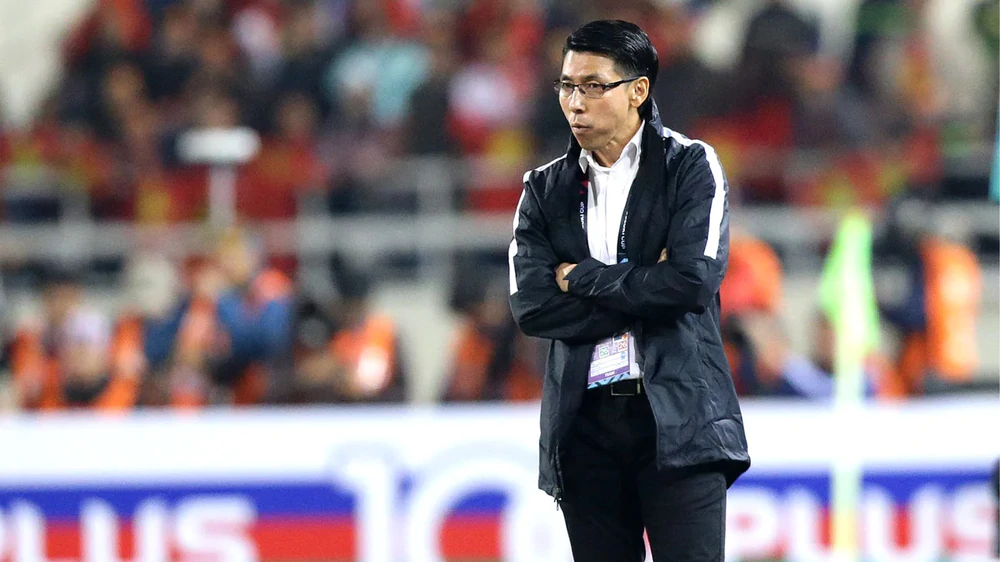
Tan Cheng Hoe is facing a difficult task
The initial answer was yes. Malaysia under Tan advanced straight to the final of the 2018 AFF Cup. More notably, the final opponent was Vietnam, a team that had been a victim of Malaysia during the years Tan served as Rajagobal's assistant. Malaysia had a very determined first leg at Bukit Jalil. Trailing 0-2 after just 25 minutes (Huy Hung, Duc Hung scored), the home team still fought back persistently and equalized 2-2 thanks to goals from Shahrul Saad and Safawi Rasid. This was clear evidence of Tan's ability to adjust and inspire. He brought Malaysia back from a situation that seemed hopeless.
But the second leg at My Dinh was a different story. The excellent combination of Quang Hai and Anh Duc scored to help Vietnam win 1-0, thereby claiming the championship with an aggregate score of 3-2. Malaysia lost, but Tan Cheng Hoe proved he could bring the national team very close to the summit.
The problem was that Tan could not turn that progress into a long-term cycle of success. Vietnam gradually became the most difficult puzzle for him. In the 6 times Tan led Malaysia against Vietnam from 2018 to 2021, Malaysia did not win, only drawing 1 and losing 5 matches.
Of course, judging Tan solely based on that statistic would be too simplistic. What is more noteworthy is that he once brought Malaysia very close to the trophy in 2018, while the current team has to start over from a completely different foundation.
Malaysian football returns to the old path
Instead of patiently building domestic strength, Malaysia pushed forward with naturalization policies and expected players of foreign origin to immediately elevate the national team. That plan once created high expectations, but then issues related to player eligibility and the naturalization process plunged Malaysia into an unnecessary crisis. The lack of many naturalized players also significantly weakened the strength of Harimau Malaya at the 2026 ASEAN Cup.
FAM appointed Tan as the interim head coach to replace Peter Cklamovski in June 2026. The reason emphasized was his experience, track record, and deep understanding of Malaysian football. In other words, Malaysia is returning to a very familiar choice after experimenting with an overly ambitious path. Tan understands local players, the training system, and the pressure a Malaysian team faces when entering big matches. That is also what makes him a potential successor to Rajagobal.
Rajagobal once proved that Malaysia could succeed without relying on a collection of 'imported' stars. Tan was the one who accompanied him through that period. Now, when the naturalization project did not yield the expected results, Tan is called back to restore the values that seemed to have been forgotten.
However, this is also the toughest test for Tan Cheng Hoe. He cannot live on past glory. The Malaysia of 2026 is very different from the Malaysia of Rajagobal, or even his own Malaysia in 2018. Regional opponents have improved, and the gap between Harimau Malaya and the leading group increasingly demands a long-term strategy. If Rajagobal was the one who ushered in the golden era, Tan Cheng Hoe could be the one to restore faith in that path. But let me reiterate, the challenge for him is immense.
Who remains from the 2018 generation?
In Malaysia's squad for the 2026 ASEAN Cup, there are exactly 2 players who played in the 2018 AFF Cup. And both are attacking players: Mohamadou Sumareh (born 1994) and Syafiq Ahmad (1995). However, neither has left much of a mark in this year's tournament. A former star who participated in 2018 but is now attending in a different capacity is Aidil Zafuan, an assistant to Tan Cheng Hoe currently.


Wonderfulshortvideo

mbappe news mbappe edit mbappe new shoe boot deal mbappe nike


julian alvarez barcelona news
James Trafford’s big moment in the U21 EURO final 🤯
RODRI BARCELONA transfer barcelona news today rodri to barcelona transfer here we go
gianni infantino and trump drama news
jorge messi death messi news today football news today
jose mourinho netflix documentary pep guardiola mourinho beef mourinho edit
 Links
Links
 Contact